
How to spot certificate programs employers actually value
A certificate can boost your resume, or be ignored. Here’s how to tell if a program will carry weight with hiring managers, with concrete checks you can run today.
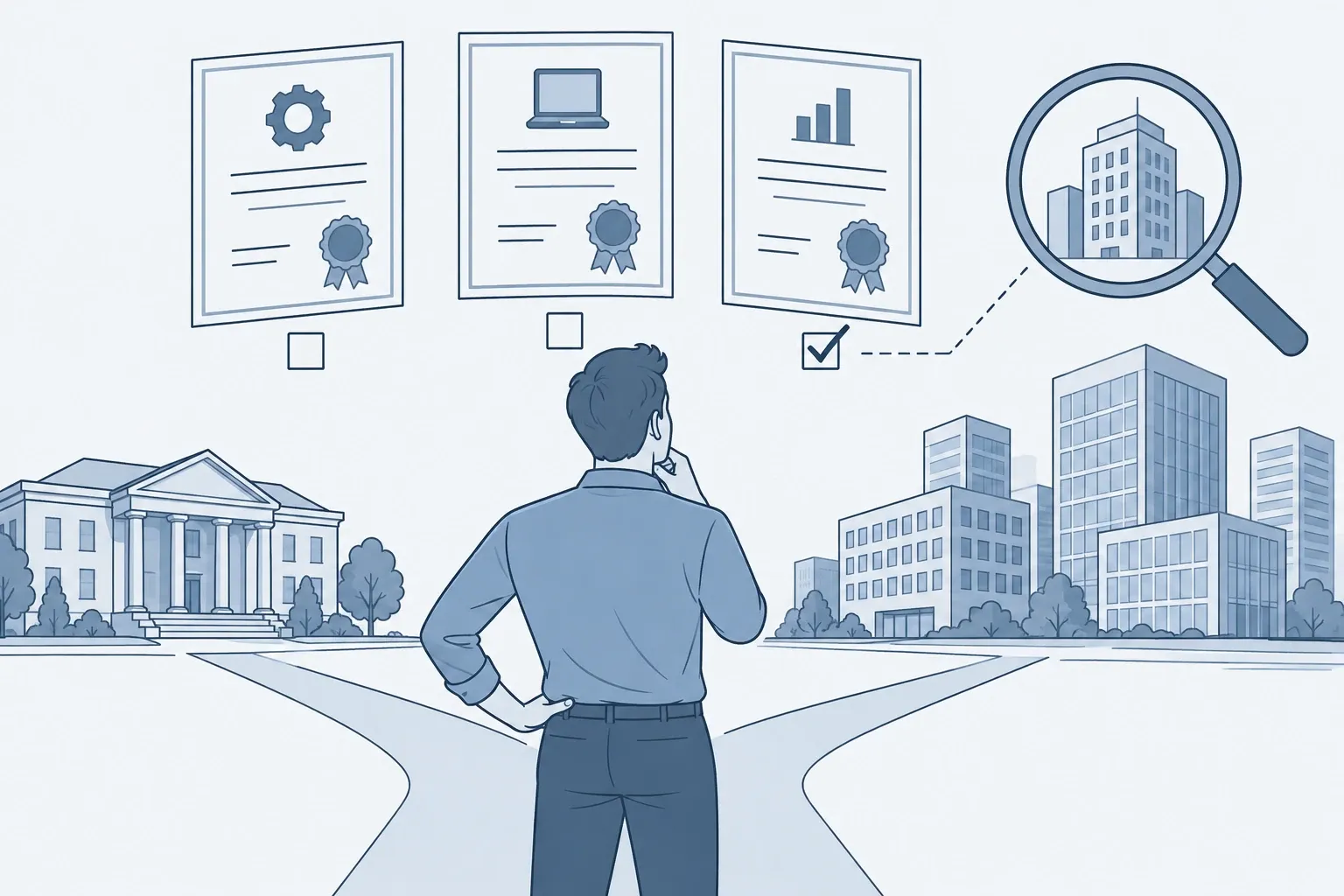
You’re comparing professional certificate programs and wondering which ones hiring managers will respect. The challenge is that “certificate” can mean very different things—from short, skills-based courses to rigorous industry certifications with proctored exams. Below, you’ll find a practical way to read the signals that matter, verify them against official directories, and choose a program that aligns with your job target and budget. If you’re also weighing general online courses, see how they differ in our overview of online courses.
First, map your goal to the right type of credential
Before comparing programs, decide what employers in your target roles actually ask for:
- Legally required license? If a job is regulated (for example, some healthcare roles), you’ll need a state license, not just a certificate. BLS distinguishes licenses from non‑government certifications and from training certificates. (bls.gov)
- Industry certification? Many roles prefer or require a certification from a professional body or vendor, awarded after you pass an exam. The BLS outlines how it measures these certifications in national data. (bls.gov)
- Academic certificate? Colleges and universities offer for‑credit or noncredit certificates. Verify the school’s accreditation through resources described by the U.S. Department of Education to avoid “diploma mills.” (ed.gov)
How to judge credibility: the signals that matter
Use these criteria to separate recognized programs from weak ones:
- Issuer and governance
- Who grants the credential? For industry certifications, look for an independent, mission‑driven body (association, board) rather than just a training vendor. For academic certificates, confirm the college’s recognized accreditation using the Department of Education’s guidance.
- Independent accreditation (not just marketing claims)
- Certification programs: Two established U.S. routes signal rigor.
- Program‑level accreditation by the National Commission for Certifying Agencies (NCCA), described by the Institute for Credentialing Excellence. (credentialingexcellence.org)
- Body‑level accreditation to ISO/IEC 17024 for personnel certification, granted by the ANSI National Accreditation Board (ANAB), with a public directory. (anab.ansi.org)
- Why it matters: These accreditations review exam development, fairness, governance and maintenance standards, not course marketing copy. ICE’s overview explains the scope of NCCA accreditation; ANAB explains ISO/IEC 17024 for certifiers. (credentialingexcellence.org)
- Assessment and renewal
- Look for proctored exams, validated passing standards, and continuing requirements (e.g., continuing education or periodic retesting). These are elements accreditors evaluate for quality.
- Employer demand
- Scan job postings for explicit mentions of the credential and talk to hiring managers. The BLS emphasizes that certifications and licenses are tracked because employers use them to verify competence, but demand varies by occupation. (bls.gov)
- Transparency
- Credible programs publish eligibility rules, exam blueprints, renewal policies and a complaints/appeals process—features accreditors require or review. ICE’s materials describe these expectations for accredited programs.
Comparing your options: what recognition looks like
| Option | Typical issuer | How recognition is signaled | What to verify |
|---|---|---|---|
| Industry certification (exam‑based) | Professional association, certification board, or vendor‑neutral body | Listing in NCCA’s accredited program directory or certification body accredited to ISO/IEC 17024 by ANAB | Find the credential or certifying body in the relevant directory and confirm it’s active and in scope. |
| Academic certificate (for‑credit or noncredit) | Accredited college or university | School holds recognized institutional accreditation; program details align with your role | Use the Department of Education resources on college accreditation to confirm status; then scan job ads to see if employers value that coursework. |
| Training course with “certificate of completion” | Bootcamp, MOOC, vendor training unit | Completion proof only; not the same as a third‑party certification | Treat as skills training. If you need a recognized credential, pair training with an accredited certification exam. See our overview of online courses for when standalone courses make sense. |
Run this due‑diligence checklist before you enroll
- Name your target roles and employers. Collect 15–20 recent postings and note any credentials listed.
- Identify the exact credential name and issuer (not just the course platform).
- Verify recognition:
- Search the NCCA accredited program directory by credential name or issuing organization on the Institute for Credentialing Excellence site.
- Search ANAB’s ISO/IEC 17024 accredited personnel certification bodies directory for the certifying body.
- For college‑issued certificates, confirm the school’s recognized accreditation with the Department of Education resources and steer clear of diploma mills and unrecognized “accreditation mills.”
- Read the exam blueprint, eligibility and renewal rules; check for proctored testing and continuing education. ICE’s materials explain why these elements matter in accredited certifications.
- Cross‑check demand by counting how often the credential appears in your job‑postings sample. BLS tracks certifications and licenses because employers use them as competence signals, but relevance is occupation‑specific.
After you earn it: how to confirm the result
- Update your resume and LinkedIn with the exact credential name and credential ID if available; many accredited programs offer a verification directory.
- Re‑scan job postings 60–90 days later to see if interview rates improve for roles that list the credential.
- Plan maintenance: add renewal dates and continuing‑education requirements to your calendar so your credential stays current—accredited programs publish these policies up front.
When a master’s may be the better signal
If your target roles consistently ask for graduate‑level depth rather than a narrow certification, compare the workload, cost and time of an online program with the value of a certification path. Start with our look at online master’s degree programs.
Frequently asked questions
What’s the difference between a certificate and a certification?
In U.S. labor statistics, a certification is a credential awarded by a non‑government body after verifying your competence, typically via an exam; a license is government‑issued and legally required for some jobs; and a certificate is training completion, often from a school. The Bureau of Labor Statistics explains the distinctions it uses in the Current Population Survey. (bls.gov)
How can I verify that a certification is independently accredited?
Look it up in an accreditation directory. Two widely recognized U.S. accreditors evaluate personnel certification programs and bodies: the National Commission for Certifying Agencies (NCCA) via the Institute for Credentialing Excellence, and the ANSI National Accreditation Board (ANAB) for ISO/IEC 17024. Both maintain public directories. (credentialingexcellence.org)
Do employers care whether a school is accredited when issuing certificates?
For academic certificates, check that the college or university is institutionally accredited by a recognized accreditor. The U.S. Department of Education explains how accreditation works and warns about diploma mills that mimic recognition. Use its resources to confirm status. (ed.gov)
Are exams or proctored assessments necessary for employer recognition?
Many industry certifications rely on proctored exams and psychometric standards, which accreditors review for fairness and validity. NCCA and ISO/IEC 17024 accreditation signal that assessment quality has been independently evaluated, a cue employers may use to gauge rigor. (credentialingexcellence.org)
Will a certification guarantee higher pay or a job?
No credential guarantees outcomes. However, BLS tracks certifications and licenses to study prevalence and their association with employment and earnings. Treat a credential as one part of your profile alongside experience and education. (bls.gov)
In this section Training