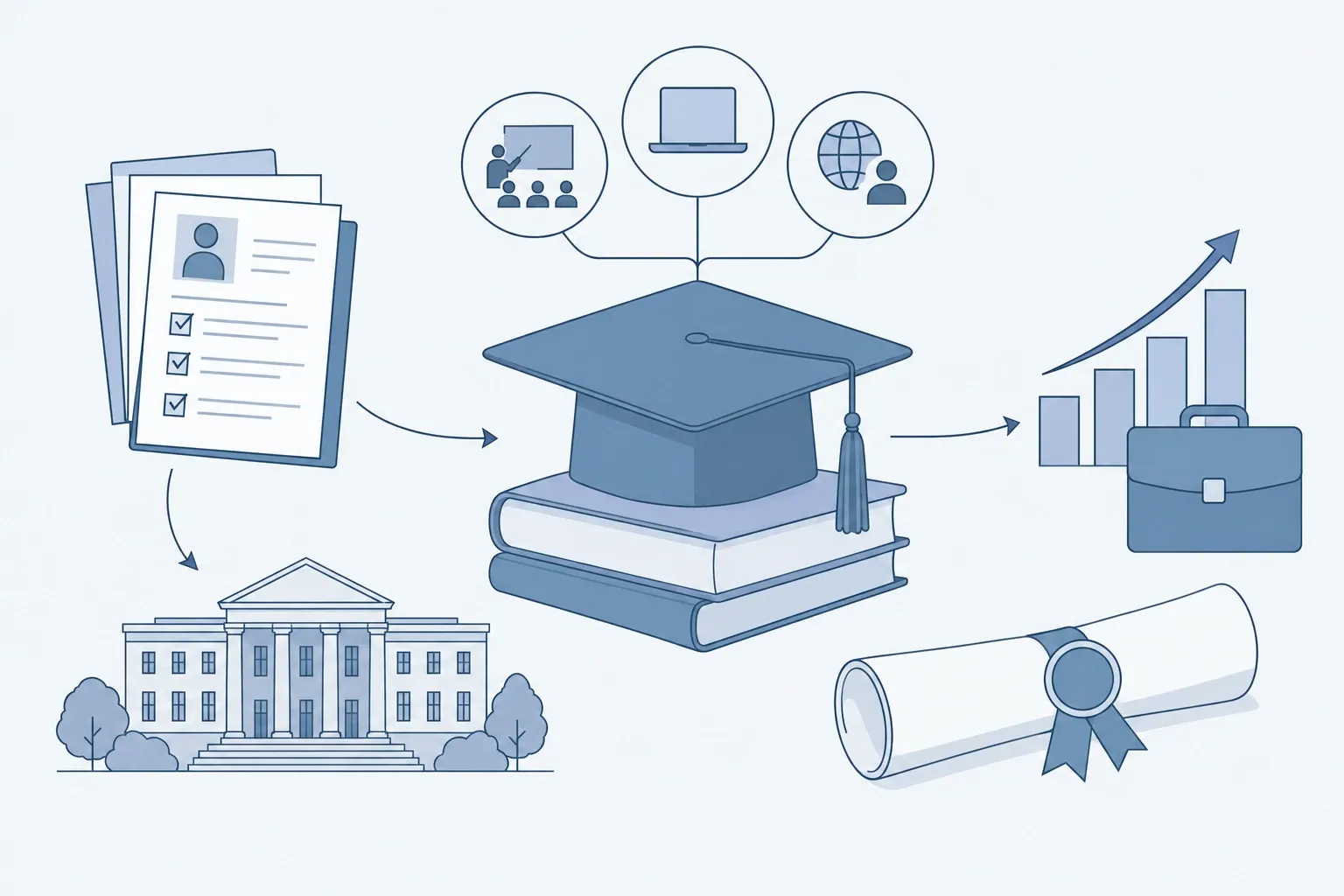
You’re weighing a bachelor’s because you want better pay, more job options or a path to graduate school. But degrees differ a lot by price, time-to-finish and payoff by major. This guide gives you the numbers that matter now, shows where the value often comes from, and helps you map a realistic route—whether you start at a community college, go in‑state at a public university, or study online—so you can choose a program you can afford and complete.
What does a bachelor’s degree change for your income and risk?
On average, a bachelor’s increases both earnings and job stability compared with only a high school diploma. In 2025, median weekly earnings were $1,578 for bachelor’s holders versus $966 for high school graduates, and unemployment was 2.8% vs. 4.3%, according to the U.S. Bureau of Labor Statistics. Your results vary by major, industry and location, so use these medians as a starting point, not a promise.
What does a bachelor’s cost in 2025–26?
Published (sticker) tuition and fees vary widely by sector. In 2025–26 the averages are: $11,950 for in‑state students at public four‑year colleges; $31,880 for public four‑year out‑of‑state; $45,000 for private nonprofit four‑year; and $4,150 for public two‑year in‑district, per the College Board Trends in College Pricing 2025 (Table CP‑1). Total student budgets—including housing, food, books, transport and other expenses—average about $30,990 for public in‑state four‑year and $65,470 for private nonprofit four‑year in 2025–26, in the same report.
Net price (what you pay after grants and scholarships) is often much lower than sticker. For first‑time, full‑time in‑state students at public four‑years, average net tuition and fees peaked in 2012–13 and declined to an estimated $2,300 in 2025–26 (in 2025 dollars), according to the College Board (Figure CP‑9).
- Public in‑state four‑year: Often the lowest four‑year sticker price. Compare program capacity and course sequencing to avoid delays that extend time‑to‑degree.
- Public out‑of‑state: Higher sticker, sometimes offset by merit aid. Run the school’s net price calculator and estimate total semesters to graduate.
- Private nonprofit: Highest average sticker, but aid can be significant. Weigh net price against program quality, outcomes and time‑to‑degree.
- Community college then transfer: A common money‑saving path. Start with general education and major prerequisites, then transfer into a four‑year program. Read our guide to the associate’s degree if you’re considering this route.
- Online programs: Useful for working students if the school and program are properly accredited. See how to judge options in our guide to online colleges.
How should you choose a major and a school you can finish?
- Start with interests and job outlook, then layer on earnings and cost. Use our playbook for choosing a college major.
- Check earnings at the program level (not just the college average). The Education Department’s College Scorecard publishes field‑of‑study outcomes; the latest dataset is available via data.gov. Compare those median earnings to your projected total cost to judge value.
- Look at completion likelihood. For first‑time, full‑time students who began seeking a bachelor’s in fall 2014, the 6‑year graduation rate was 64% across four‑year institutions, per NCES Fast Facts. Select programs with strong term‑by‑term course availability, advising and support.
- If graduate school is likely in your field, preview requirements now so your bachelor’s coursework builds the right prerequisites. Then explore when a master’s degree pays off.
Build a short list and a realistic budget in four steps
- Frame your ceiling. Use the sector averages above from the College Board to set a target annual budget for tuition plus living costs.
- Price the programs. For each school, note published tuition and typical housing/food. Focus on net price and how many terms you’ll likely need to finish based on course sequencing and your transfer credits, if any.
- Stress‑test the payoff. Compare your likely total cost to program‑level earnings five years after graduation using the College Scorecard field‑of‑study data for your major at each school.
- Decide your path. If money is tight or you want to work while studying, consider starting with an associate’s degree and transferring, or choose an accredited option from our guide to online colleges.
Before you enroll, sanity‑check your plan
- Time: Programs marketed as “four‑year” can take longer if courses are capped or not offered every term. Use departmental sample plans and ask about average time‑to‑degree in your major.
- Money: Budget for the full student cost of attendance, not just tuition. The College Board shows that housing, food, transportation and other expenses add materially to annual cost.
- Outcomes: Cross‑check your target programs against program‑level earnings using the College Scorecard, and against national medians from the BLS. For majors where pay varies widely, also see our look at the highest‑paying college majors.
What’s next?
- If you’re early in your journey or cost‑sensitive, compare starting with an associate’s degree and transferring into a bachelor’s.
- If you’re deciding between several fields, use our guide to choosing a college major.
- If you’re already thinking beyond the bachelor’s, read when a master’s degree pays off for your field.
- If you need flexibility, shortlist programs from our guide to online colleges.
Frequently asked questions
Is a bachelor’s still worth it in 2026?
On average, yes—graduates earn more and face lower unemployment. In 2025 BLS reported median weekly earnings of $1,578 for bachelor’s holders versus $966 for high school graduates, and unemployment of 2.8% vs. 4.3%. Those are national medians; your major and location matter. See the latest BLS table for details.
How much should I budget beyond tuition?
Student budgets include housing, food, books, transport and other costs. In 2025–26, the College Board estimates average total budgets of about $30,990 for in‑state public four‑year students and $65,470 at private nonprofits. Your actual net price falls after grants and scholarships.
Can starting at a community college save money without hurting outcomes?
Often, yes—especially for in‑state transfers with a clear major plan. Average published tuition and fees at public two‑year colleges are far lower than at four‑year schools in 2025–26. The key is confirming transfer pathways and course equivalencies before you start so credits apply to your target major.
What if I plan to go on to a master’s later?
Choose an accredited bachelor’s that builds prerequisites and quantitative skills for your target master’s. Many graduate programs weigh GPA, course rigor and research or work experience. If a master’s is likely in your field, also evaluate the bachelor’s program’s time-to-degree and cost to limit total debt.
How do I compare earnings by major and school?
Use program‑level outcomes. The U.S. Department of Education’s College Scorecard publishes field‑of‑study earnings; you can look up the latest datasets and filter by major and institution. Compare those to your likely total cost and time-to-degree to assess payoff.